
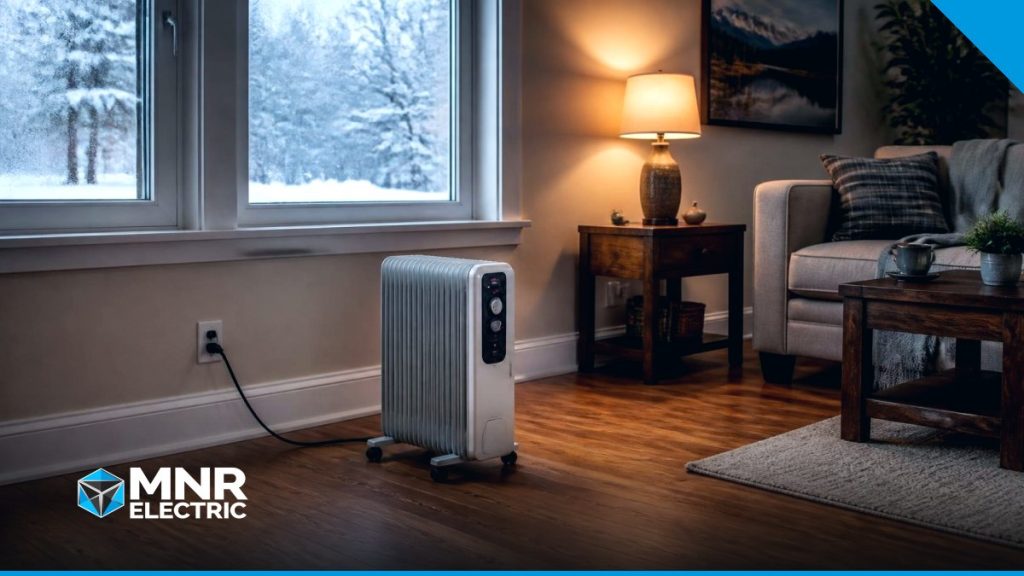
A space heater is safe when it is plugged directly into a wall receptacle on a circuit that is not running anything else, sits on a hard level floor at least one metre from anything that can burn, has a tip-over switch, and is switched off when you leave the room or go to sleep. The reason those rules are strict is arithmetic: a typical 1,500 watt heater uses almost the whole capacity of a standard 15 amp household circuit by itself.
The 1,500 watt problem
Most portable heaters sold in Canada top out at 1,500 watts, and most bedroom, living room and basement receptacles in Edmonton homes sit on 15 amp, 120 volt circuits. Divide 1,500 watts by 120 volts and the heater pulls 12.5 amps, which is 83 percent of the breaker’s rating. The circuit has about 300 watts left for everything else wired to it: the TV, a lamp, a phone charger, the receptacle in the next room that happens to share the same breaker.
Breakers are designed to allow a load like this for a while, which is why the heater runs fine for an hour and then trips the circuit at 2 am when the furnace fan or the fridge on the same circuit cycles on. If the breaker keeps tripping, the circuit is telling you it is full. Our post on why breakers trip at minus 30 walks through finding what else is on the circuit.
Two heaters on one circuit is never fine. Two heaters on two receptacles that turn out to share one breaker is the same problem wearing a disguise.
Why outlets and cords melt
Twelve and a half amps for hours at a time is a heavy, continuous load, and heat builds up wherever resistance is highest. Three places fail:
- Worn receptacles. A receptacle that has had plugs pushed in and pulled out for 40 years grips loosely. A loose contact carrying 12.5 amps gets hot, the plastic softens, the contact gets looser, and the cycle feeds itself. If a heater plug feels warm, or slides in with no resistance, or the receptacle face is discoloured, the receptacle is done.
- Extension cords and power bars. Most household cords and power bars are built for lamps and electronics, not a 12.5 amp continuous load. Thin conductors heat up, the plastic plug on a cheap power bar softens, and the fire starts at the connection. Edmonton Fire Rescue is blunt about it: plug space heaters directly into the wall outlet, never into an extension cord.
- Aluminum wiring connections. In homes from the mid-1960s to late 1970s, a standard receptacle on aluminum conductors is already the weakest connection in the room. A space heater on that receptacle is the load most likely to find it.
Signs the circuit is overloaded or a connection is failing: a plug or cover plate warm to the touch, a smell of hot plastic, lights on the same circuit dimming when the heater cycles, buzzing or crackling from the receptacle, or a breaker that trips without an obvious cause. Any one of those means unplug the heater and leave it unplugged until the circuit has been checked.
Placement, clearance and the tip-over switch
The electrical side is only half of it. Edmonton Fire Rescue’s winter guidance covers the rest:
- Keep anything that can burn at least one metre (three feet) from the heater: bedding, curtains, laundry, furniture, paper, the dog bed.
- Choose a heater with a tip-over automatic shut-off and overheat protection, and set it on a solid, flat, hard surface. Not on carpet with a long pile, not on a bed, not on a dresser.
- Turn the heater off and unplug it when you leave the room or go to sleep. The convenience of waking up warm is not worth running a 1,500 watt appliance unattended for eight hours.
- Keep heaters out of bathrooms and wet areas unless they are specifically designed for it.
- Look for a recognized Canadian certification mark (CSA, cUL or cETL) on the heater and discard any unit with a damaged cord or plug.
Edmonton Fire Rescue says heating devices cause a number of fires in the city each cold season. Nationally, Statistics Canada’s most recent release covering 2021 counted 10,819 residential fires in the reporting provinces, with mechanical or electrical failures or malfunctions responsible for 18 percent of residential fires, 15 percent of injuries and 10 percent of deaths. Heating equipment is not broken out separately, but a space heater on a worn receptacle is exactly the kind of failure that category describes.
Why Edmonton homes have cold rooms
Edmonton averages about 25 days a year at or below minus 20, and January’s mean daily low is around minus 15. In that climate a room above an unheated garage, a basement bedroom at the end of a long duct run, a bay window addition or a bonus room over the front entry will run several degrees cooler than the thermostat reads. The space heater is a symptom; the room has a heating problem, not a temperature preference.
A space heater is a fine answer for an evening. It is a poor answer for a whole winter, and a dangerous one when it becomes permanent furniture in a child’s bedroom.
The permanent fix: a dedicated circuit or baseboard heat
If a room needs supplemental heat every winter, the safe solution is to give that heat its own circuit so it stops competing with everything else:
- Electric baseboard or a wall heater on a dedicated 240 volt circuit, controlled by its own thermostat. Under the Canadian Electrical Code, dwelling-unit heaters can share a branch circuit protected at no more than 30 amps (Rule 62-114), and heaters near sinks, tubs and showers have clearance rules of their own (Rules 62-130 and 62-132), so the layout is part of the design.
- A dedicated 20 amp receptacle for a portable heater, so that the heater is the only thing on the breaker. Less ideal than fixed heat, but a real improvement in a home office or workshop.
- Replacing the worn receptacle you have been plugging into, which is a smaller job and often overdue in older homes.
All three involve new or altered wiring, and the City of Edmonton requires an electrical permit for new circuits and receptacles. We pull the permit, size the circuit, and check that your panel has the capacity. If it does not, that conversation belongs on our electrical panel upgrades page. You can request a free estimate for any of these.
When to call an electrician
Call a licensed electrician when a breaker trips repeatedly with the heater on, a receptacle or plug is warm, discoloured or loose, you smell hot plastic, lights dim when the heater cycles, your home has aluminum wiring and you want to run a heater anywhere, or you want a dedicated circuit or baseboard heat installed. Those are home electrical repair calls, and they are far cheaper than the alternative. If a receptacle is smoking or you see scorching, shut off the breaker and call our 24 hour emergency line at 780.466.9106.
Quick answers
Can I plug a space heater into a power bar or extension cord?
No. A 1,500 watt heater draws about 12.5 amps continuously, more than most cords and power bars are built for, and the connection overheats. Edmonton Fire Rescue says to plug heaters directly into a wall receptacle.
How many space heaters can run on one circuit?
One. A 1,500 watt heater uses about 83 percent of a 15 amp circuit’s capacity on its own. Two heaters on the same breaker will trip it or overheat the wiring.
How far should a space heater be from furniture or bedding?
At least one metre (three feet) from anything that can burn, on a hard, level surface, with a tip-over shut-off.
Why is my outlet hot when the space heater is plugged in?
A loose or worn contact in the receptacle, a loose wiring connection, or an overloaded circuit. Unplug the heater, stop using that receptacle and have an electrician replace or repair it.
What is the permanent fix for a cold room?
A dedicated heating circuit: electric baseboard or a wall heater on its own 240 volt circuit with a thermostat, or at minimum a dedicated receptacle for the heater. Both need an electrical permit in Edmonton.